East West Rail: linking 'Europe's Silicon Valley'
January 29, 2026
-
Part 1: The Varsity lineRailway Mania brought about the Varsity line's construction. Beeching's fundamental misunderstanding of railway networks closed it – though the Marston Vale line survived against the odds.
-
Part 2: Linking 'Europe's Silicon Valley'Why rebuilding makes economic sense now: Oxford-Cambridge Supercluster's £135bn economy that needs better connectivity, EWR's three-stage delivery plan, and the controversies that could undermine it.
-
Part 3: Beyond the platformDetermining success or failure: first- and last-mile connectivity. Why UK transport planning consistently fails, what Dutch and German systems do differently, and how East West Rail could finally break the pattern.
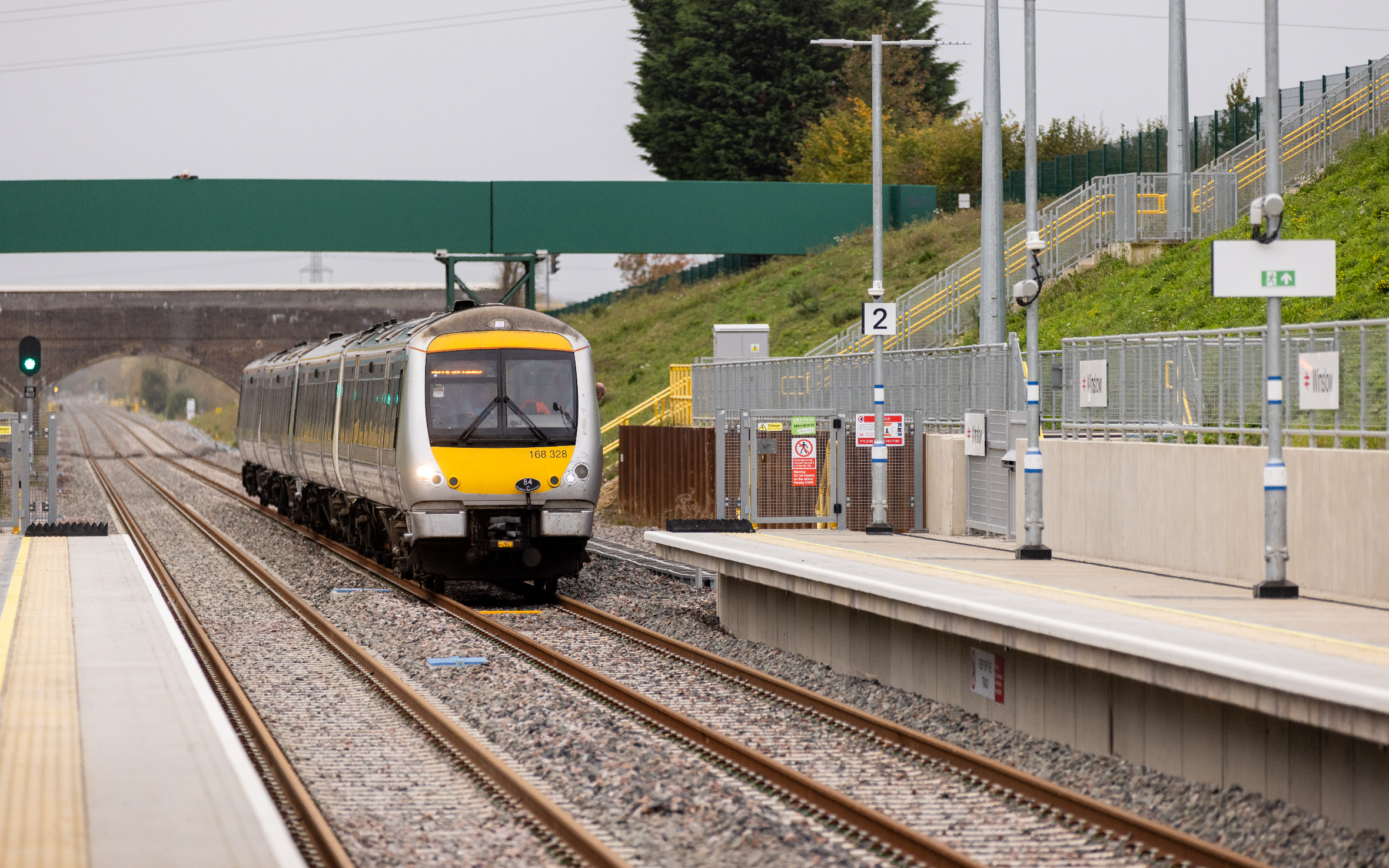
A test train at Winslow station on the new Bicester–Bletchley section
As detailed in Part 1, Beeching’s cuts intensified the London-centric pattern by closing cross-country routes whilst preserving radial trunk routes.
The Varsity line closed in 1967 because it didn’t fit the vision of a car-based future. East West Rail is being rebuilt because it fits the current vision shaped by the climate crisis, the housing shortage, congested roads, and the economic need to connect knowledge cluster. The circumstances that justified closure have reversed. What looked rational in the 1960s now appears as short-sighted destruction of valuable infrastructure. The question isn’t why rebuild the Varsity line, but why it took decades to realise closing it was a mistake.
Four shifts explain why EWR makes sense now when it didn’t during the Beeching era. The UK’s rail network topology remains inadequate for east-west travel south of Birmingham, forcing circuitous journeys that make no sense in the 21st century. Government policy has evolved from treating cars as the solution to recognising them as part of the problem, with legally binding Net Zero targets requiring modal shift from roads to rail. Housing policy now explicitly links infrastructure provision to development, with the Oxford-Cambridge Arc designated as a priority growth region with the government saying it “has the potential to be Europe’s Silicon Valley”. Multiple failed attempts to reopen the route over three decades have finally converged into political consensus and funding commitment.
Research by Venter et al. (2023) analysing East West Rail’s development trajectory identifies this convergence of factors as critical – a pattern absent in earlier failed reopening attempts. Each of these would be insufficient alone, but together they create the right conditions for East West Rail to proceed where previous schemes collapsed.
Shifting perspectives
Network topology
The network evolved radially from London during the Victorian era. Beeching’s cuts intensified this pattern by closing cross-country routes whilst preserving radial trunk routes. This ignored that cross-country routes fed traffic onto trunk routes.
Sixty years later, the topology remains inadequate for east-west travel south of Birmingham. Oxford to Cambridge takes 2 hours 45 minutes via London or 3 hours 15 minutes via Birmingham. By car, 2 hours when traffic cooperates, which along the congested A421 and A428 is a pipe-dream. Neither option is acceptable for regular travel.
The economic geography has also changed since the 1960s. Knowledge-intensive sectors concentrated in Oxford, Cambridge, and along the corridor depend on labour mobility, collaboration, and access to facilities. When Oxford’s materials scientists can’t easily visit Cambridge’s biomedical campus, or Milton Keynes’ companies can’t recruit Cambridge researchers because commutes are impractical, it’s clear that the network topology is limiting productivity. This isn’t to say that these issues are unique along the corridor, but it combines strong economic activity with government designation and political consensus, making it viable whilst other projects struggle.
Modal shift from car dependency
Beeching assumed rising car ownership made branch railways obsolete. Motorways would provide modern connections; cars would handle local travel. This vision dominated transport policy through the 1970s and 1980s. The M25, completed in 1986, symbolised this: build more road capacity to solve congestion. In fact, the M25 wasn’t intended to be the only London orbital, the Ringways project had three additional motorways encircling London.
Just one more lane will fix traffic! Nope…
Adding more road capacity doesn’t solve congestion, counterintuitively, it induces more demand. The M25 opened with chronic delays, has required widening multiple times, yet remains one of Britain’s most congested roads. The A421, a strategic link along the EWR corridor, is also regularly congested despite recent construction. National Highways projected that over 100,000 vehicles would use the A6–A600 section (south of Bedford) each day by 2040, this was before Comcast had even considered Bedford as Universal’s UK resort location.
By the 2000s, the limitations of car dependency became apparent. Urban air quality deteriorated, with transport emissions causing thousands of premature deaths annually. Simultaneously, road congestion cost the economy billions in lost productivity – you can’t work if you’re stuck in traffic. Since the 1960s, climate change has transformed from an abstract threat to immediate policy concern. The 2008 Climate Change Act established legally binding emissions reduction targets, with the subsequent Net Zero by 2050 commitment fundamentally changing the policy context.
Modal shift from cars to rail is a legal requirement to meet Net Zero targets, an economic necessity to reduce congestion, and a public health priority to improve air quality – not and environmental luxury or lifestyle choice. Rail offers substantially lower emissions per passenger-mile than cars, occupies a fraction of the land needed for equivalent road capacity, and enables passengers to work during travel (the productivity premium that makes rail time less costly than driving time for knowledge workers).
The Department for Transport’s appraisal framework now explicitly values carbon reduction, air quality improvement, and congestion relief, all factors that would have been ignored in Beeching’s cost accounting.
Housing crisis and spatial planning
The housing crisis affects economic growth, productivity, and social mobility. House prices in Cambridge and Oxford are among the highest in the UK outside London, with average homes costing 15-20 times median incomes. Young professionals working in knowledge-intensive sectors struggle to afford housing near their workplaces, forcing longer commutes or deterring them from taking jobs in the region. Companies report recruitment difficulties when candidates face housing costs that offset salary premiums. Workers living far from jobs increases transport costs and time, reduces labour market flexibility, and constrains business growth.
The issue is supply constraint. Cambridge and Oxford are historic cities with limited development opportunities, due to Green Belt designations, floodplains, conservation areas, and strong local opposition to large-scale development, all restraining growth. The surrounding countryside faces similar constraints, with rural character, agricultural land, and environmental designations limiting housing delivery. Building substantial new housing outside traditional boundaries, enabled by infrastructure that makes new locations practically accessible, is a viable solution to this.
The Oxford-Cambridge Arc spatial strategy, first published in 2021 and renewed under the current Labour government, explicitly links infrastructure investment to housing delivery. The target is 1 million new homes by 2050, concentrated in new settlements and extensions to existing towns along the EWR corridor. Tempsford, currently a village of 500 people beside the planned EWR station, is designated for development into a new town of 10,000+ homes. Cambourne, a rapidly growing new town from the 2000s, will see further. Existing settlements like Bedford and Milton Keynes will expand further. It’s planned, transit-oriented development at scale, not urban sprawl.
Build EWR without housing delivery, and the business case weakens because demand growth disappoints. Attempt housing delivery without EWR, and you create car-dependent sprawl that worsens congestion and emissions whilst failing to provide the quality of life that attracts knowledge workers. Ultimately, the two must happen together. The policy logic is straightforward: infrastructure enables development, and development justifies infrastructure investment.
Tempsford serves as a model for this. Agricultural land beside the East Coast Main Line becomes viable for a planned new town because the EWR station creates accessibility. Cambridge could be reached in 35 minutes, Oxford in 75 and London in 45. Without EWR, it remains farmland. By expanding effective labour markets, EWR increases productivity, raises taxable incomes, and reduces the fiscal drag imposed (at least in some part) by housing scarcity.
Political evolution
East West Rail isn’t the first attempt to reopen the Varsity line. Multiple proposals emerged through the 1990s and 2000s, mostly from private sector promoters hoping to operate commercial services. All failed, collapsing when funding couldn’t be secured or when planning opposition proved insurmountable.
In 2011, councils along the route formed the East West Rail Consortium, pooling resources and political influence to lobby central government. Its credibility came from representing local support rather than speculative private schemes. The central government responded with funding for feasibility studies, then for design work, and eventually for construction. In 2017, the East West Rail Company (EWR Co.) was established as a government-owned entity to deliver the project, giving it stability and funding access.
The political consensus around EWR is rare in UK infrastructure context. Both Conservative and Labour governments have supported funding through multiple spending review cycles. Local authorities across the route, regardless of political control, back the project. Business organisations, universities, and environmental groups form an unusual coalition of support. This consensus doesn’t mean it’s opposition free – specific controversies around route choice, station closures, and land acquisition provoke heated local debates – however, the principle of enhancing east-west rail connectivity faces minimal organised opposition.
The economic case, supported by the Supercluster data, helps maintain political support. EWR can point to concrete employment figures and growth rates rather than speculative projections.
The Oxford-Cambridge Arc designation creates policy alignment between transport and housing, giving EWR a role in addressing the housing crisis rather than being purely a transport scheme. And the climate policy context means that rail investment aligns with Net Zero commitments, whereas road building faces increasing skepticism. This convergence of factors creates conditions for success that previous attempts lacked.
And it only took over half a century…
Regional connectivity: the supercluster economy
The Oxford–Cambridge corridor is already one of the UK’s most dynamic economic regions. The arc, spanning Oxford, Bicester, Milton Keynes, Bedford, and Cambridge, is home to 19,000 companies employing 570,000+ people with a combined turnover of £135 billion. The region has added 125,000 jobs since 2015, more than any UK city except London and Manchester, consistently outpacing national economic growth.
This economic powerhouse operates with lackluster east-west connectivity. East West Rail, along with National Highways’ A421/A428 Black Cat–Caxton Gibbet upgrade, addresses this strategic infrastructure deficit. The corridor can grow – the lack of suitable infrastructure is what’s holding it back. Together, these investments address both passenger and freight constraints, allowing east–west growth without simply shifting pressure onto already congested north–south routes.
The foundations of innovation
The arc’s economic strength rests on two world-leading research universities. Oxford ranks first in the Times Higher Education World University Rankings 2026, with Cambridge placing third. Evidently, academic prestige translates directly into economic impact. The two universities have collectively launched over 400 spin-out companies. The concentration of highly skilled researchers has attracted major institutes and multinationals, including the Diamond Light Source at Harwell and AstraZeneca’s R&D headquarters at the Cambridge Biomedical Campus.
Between 2015 and 2025, Oxford and Cambridge spin-outs attracted more venture capital than any other UK city except London, creating a virtuous cycle where successful entrepreneurs mentor later spin-outs and reinvest their profits.
The effects of this can be seen in the region’s innovation intensity. Cambridge ranks as the second most innovative city globally out of 237 cities assessed by the World Intellectual Property Organisation, whilst Oxford ranks fifth. Knowledge-intensive (K.I.) sectors (IT, life sciences, advanced manufacturing, R&D) account for 14% of regional employment compared to just 9% nationally, with over 152,000 people working in these sectors. This concentration reflects decades of scientific breakthroughs and the kind of agglomeration effects that economists recognise as drivers of productivity growth.
But even organic growth driven by research excellence needs infrastructure. The innovation cluster falls short when researchers face 2 hour 45 minute journeys between the two anchor universities, when early-stage companies struggle to recruit talent because commutes are impractical, or when collaboration that should be routine requires half-day travel commitments.
Cambridge
Cambridge accounts for 46% of the Supercluster’s knowledge-intensive employment, with life sciences dominant. Life sciences account for 42% of large knowledge-intensive employment, with IT/telecoms and advanced manufacturing each at 23%. The Cambridge Biomedical Campus – anchored by AstraZeneca’s R&D headquarters, the Wellcome Sanger Institute, and major NHS facilities including Addenbrooke’s and Royal Papworth hospitals – is projected to exceed 30,000 jobs by 2030.
Growth is now constrained less by demand than by connectivity. Congestion on the sub-optimal road network, combined with rail services that remain largely radial and London-focused, restrict the effective labour market. This narrows the available talent pool, intensifies skills shortages, and increases wage pressure, limiting the efficiency of further expansion.
East West Rail expands Cambridge’s functional labour market westwards, allowing growth to be accommodated through improved access to labour rather than further densification within an already overheated housing market. Cambridge South station supports this approach by embedding high-capacity, low-car access directly into the biomedical campus. The station is designed to be effectively car-free, with around 1,000 cycle parking spaces and a target for approximately 95% of trips to be made by walking, cycling, or public transport, avoiding additional pressure on Cambridge’s constrained road network.
Oxford
Oxford’s economy combines high-value manufacturing, life sciences, and specialist services, with particular strength in Formula 1 engineering and scientific instrumentation. Firms such as Oxford Nanopore Technologies demonstrate the region’s capacity to translate research excellence into commercial impact.
The main issue here is fragmentation. Oxfordshire’s most important research assets are dispersed beyond the city with weak connectivity between them. Harwell Campus, located around 12 miles south of Oxford, and Culham Science Centre together employ over 6,000 people in strategically important roles, including facilities such as the Diamond Light Source synchrotron and the Rutherford Appleton Laboratory. Rail access is either absent or constrained by infrequent, radial services, restricting labour mobility and suppressing collaboration between institutions that should function as a single research ecosystem.
Oxford Parkway shows the limits of incremental interventions. Whilst effective as a park-and-ride for the A34 corridor, it remains London-oriented and does little to improve east–west connectivity between Oxford’s research sites or with the wider Supercluster.
Central Region
The central region – Bedford, Milton Keynes, and the corridor between them – already employs over 40,000 people in knowledge-intensive sectors, around a quarter of the Supercluster total. Milton Keynes, with a population exceeding 280,000, is larger than Cambridge and hosts both the Open University and the newly established MK:U (opened 2024). Bedford, with over 100,000 residents, lies on a strategic junction between the Midland Main Line and East West Rail.
Despite this, the region functions in relative isolation. Advanced manufacturing (including Mercedes-Benz Grand Prix at Brackley), aerospace, digital services, and a meaningful life-sciences base are already present, with firms choosing the area for engineering talent, proximity to Motorsport Valley, and lower operating costs than Oxford or Cambridge. The constraint is connectivity: recruiting researchers from Oxford or Cambridge is impractical, and collaboration between MK:U, the Open University, and neighbouring research institutions is limited by journey times.
East West Rail directly addresses this constraint. Oxford–Milton Keynes falls to around 35 minutes, compared with roughly 1 hour 45 minutes today, with Cambridge–Bedford drops to around 50 minutes from close to two hours. This enables regular interaction across institutions and firms, allows the existing employment base to scale, and integrates the central region into the wider innovation economy – relieving pressure on Oxford and Cambridge while increasing overall productivity across the corridor. The scale of change delivered by East West Rail is best seen through journey times.
Journey time comparisons
| Journey | Transport | Car | EWR | Saving |
|---|---|---|---|---|
| Oxford–Cambridge | 2h 45m | 2h | 1h 30m | 1h 15m (45%) |
| Oxford–Bedford | 2h 30m | 1h 30m | 55m | 1h 35m (63%) |
| Oxford–MK | 1h 45m | 1h 10m | 35m | 1h 10m (66%) |
| Cambridge–MK | 2h 30m | 1h 30m | 1h | 1h 30m (60%) |
| Cambridge–Bedford | 2h | 1h | 50m | 1h 10m (58%) |
Journey times on the EWR alignment by current transport, car and EWR
East West Rail is competitive with car journey times even before factoring in congestion, parking, and driver fatigue. When accounting for Cambridge’s A14/A428 congestion and Oxford’s similar issues, rail clearly becomes superior. More importantly, passengers can work on trains – a researcher travelling Oxford to Cambridge can draft papers, analyse data, or prepare presentations rather than losing three hours to driving and parking.
Research by Azoulay et al. (2010) demonstrates that the death of an eminent “superstar” scientist causes an immediate 5-8% decline in research output among their collaborators. Critically, this effect is strongly mediated by geographic proximity: co-located researchers experience the sharpest productivity decline, whilst distant collaborators are less affected. The mechanism matters for EWR’s economic case. Face-to-face interaction enables tacit knowledge transfer – the informal conversations, equipment demonstrations, and spontaneous problem-solving that published papers cannot capture. When Oxford’s materials scientists and Cambridge’s biomedical researchers are separated by 2 hour 45 minute journeys, these interactions simply don’t happen.
The relationship between travel time and collaboration is non-linear: halving journey time roughly doubles collaboration rates. Regular, productive collaboration (weekly meetings, graduate student exchanges, shared equipment use) requires journey times under 90 minutes each way. At 2 hour 45 minutes, collaboration becomes occasional and formal (quarterly meetings, conference presentations). At 1 hour 30 minutes, it becomes routine and generative.
The network effect matters: it’s not about any single journey becoming faster, but about the entire region becoming functionally connected.
The plan


An overview of the EWR route
Phased delivery
East West Rail is being delivered in three sections, each at a different stage of development:
- Oxford–Bletchley (CS1): the western section, operational Oxford–Bicester since 2016, with Bicester–Bletchley services starting this year
- Bletchley–Bedford (CS2): the first half of the central section, the current Marston Vale line
- Bedford–Cambridge (CS3): the second half of the central section, a new line under construction and planning, expected to open in the early 2030s
- Cambridge–Ipswich onwards: the eastern section, not a part of plans currently
The phased approach reflects both funding realities and technical complexity, allowing parts of the route to open before full completion.
Western section: proof of concept
The Western Section, also known as Connection Stage 1 (CS1), has been partially operational since 2016, demonstrating that demand exists and building political momentum for the wider project. The route runs from Oxford through Oxford Parkway and Bicester Village to Bletchley (though the Bicester–Bletchley finished construction in 2024, there is no public start date for services), using a combination of existing infrastructure between Oxford and Bicester, and reopened trackbed from Bicester to Bletchley via Winslow. The section has passive provision for electrification. Oxford Parkway functions primarily as a park-and-ride facility for the A34 corridor, whilst Bicester Village serves the major retail destination of the same name. Winslow station, closed in 1968, will reopen as part of the project with the expectation that residents from the local villages will drive there.
Chiltern Railways operates services, with hourly off-peak frequency increasing at peak times, and through services continuing to London Marylebone via Bicester. Ridership has exceeded projections, particularly at Bicester Village, proving the concept and validating the business case for reconstruction. However, the Western Section’s limitation is clear: passengers are still required to change at Bletchley for eastwards travel, meaning the full benefits of Oxford-Cambridge connectivity remain unrealised until the Central Section completes.
Central section: upgrades and new alignment
The Central Section is where complexity, cost, and controversy concentrate. This is the most challenging part of the project due to its mix of upgraded existing infrastructure and new construction, opposition to new route alignments, navigation through urban areas (particularly Bedford), and environmental constraints. The section is currently under construction and advanced planning, with a target completion in the mid-to-late 2030s.
The Bletchley to Bedford (CS2) segment uses the existing Marston Vale Line trackbed but requires substantial upgrades: complete double-tracking (currently mixed single and double track), station rebuilds to modern accessibility standards, and signalling upgrades to support increased frequency. The controversial station consolidation plan, favoured by EWR Co. as of late 2025, would replace ten intermediate stations with five, reducing the current twelve stops in 16.5 miles whilst improving facilities at the consolidated locations. The upgraded line would carry 5 trains per hour (up from the current 1), with 4-car trains (or 5-cars currently being considered by EWR) replacing the current 2-car formations. Target completion for this segment is the early 2030s.
Bedford station itself presents the project’s critical pinch point. The station already serves as a major junction for the Midland Main Line (London St Pancras to Sheffield) and the Marston Vale Line, and adding EWR services requires expansion from the current five platform faces to seven – demanding land acquisition adjacent to the existing Midland Main Line, significant demolition and construction work in the town, and years of disruption. Without this expansion, the junction cannot reliably handle the additional EWR services, risking conflicts between routes and unreliable performance on the Midland Main Line, too. There is no viable bypass option – Bedford is a major destination and must be served directly. The expansion enables Bedford to function as a genuine regional hub rather than a bottleneck constraining the entire network. Bedford St. John’s station will also be expanded and relocated to be closer to the hospital, making it more accessible.
From Bedford eastwards (CS3), the route is largely new construction on greenfield land. The alignment runs Bedford to Tempsford to Cambourne before connecting into Cambridge. Tempsford, currently a village of 500 people, will gain an entirely new station as the focus of a planned new town development of 10,000+ homes. Cambourne, a rapidly growing new town from the 2000s that currently has no rail access, gains connectivity to the wider region. Some sections mirror the new A421/A428 dual carriageway, with environmental mitigations including wildlife crossings, extensive tree planting, and noise barriers in residential areas.
The route approaches Cambridge from the south via a new junction onto the realigned Shepreth Branch Line. Trains will serve three Cambridge stations: Cambridge South (within the Biomedical Campus, opening this year), Cambridge (the city center station), and potentially Cambridge East – a planned, unfunded station on the line to Newmarket that would serve new housing developments, Cambridge City Airport, the Arm campus, and Peterhouse Technology Park. It is currently being “investigated” by EWR, stopping short of proposal.
Operations and rolling stock
Currently, the Oxford–Bicester (to London Marylebone) services are operated by Chiltern Railways with their diesel Class 165/168 fleet. Once the line between Bicester and Bletchley opens, Class 196s leased from West Midlands Trains will operate the route, also diesel sets. The opening has been put on hold due to a dispute over Driver Only Operation (DOO) between unions and the train operating company.
Full operations
Initially, EWR Co. planned to use 4-car battery-electric trains to run the full route, with newly constructed stations having platforms capable of berthing them. However, as of the autumn You Said, We Did consultation response report, they are now favouring 5-car operations in response to increased expected demand – the Universal effect. Stations such as Winslow and Bletchley high-level can only accommodate 4-car trains, which means lengthening platforms on the section which was due to open last year. Though the exact service pattern is yet to be available, the trunk route is expected to see five trains per hour in the peak (also increased in the report from three), with one freight train per hour.
Controversies
EWR, like many other large-scale infrastructure projects, does have some reasonable opposition – at least to certain parts of the scheme. Some reflect genuine trade-offs with no perfect answer; others are borne by tensions between local and regional priorities. Whether EWR will or won’t deliver on its promises rests on understanding these controversies.
Discontinuous electrification
Full electrification was abandoned due to cost concerns, though the line includes passive provision for overhead wires (bridge clearances, tunnel heights, etc.). Instead, EWR has adopted discontinuous electrification using battery-electric trains. This requires power delivery infrastructure – either overhead wires in sections or fast charging units at stations, as seen on GWR’s Greenford–West Ealing shuttle. GWR’s battery train trials set distance records last year, proving the technology’s viability.
Only diesel, bi-mode, and battery-electric trains can operate on the full route. This creates EWR’s most significant sustainability contradiction: it locks out electric freight locomotives entirely. For a railway designed to carry freight between Felixstowe (and other East Coast ports), the Midlands and beyond, it’s a fundamental oversight. Electric freight is essential for Net Zero targets – forcing diesel locomotives onto a railway marketed as a climate solution undermines the modal shift argument. The line was justified partly on emissions reduction, yet its design prevents the cleanest freight technology from using it.
EWR’s position is pragmatic: battery technology is improving, costs are falling, and the line can open sooner without awaiting full electrification. Electrification could be added later, as the Midland Main Line programme has demonstrated. But UK infrastructure history suggests “temporary” compromises often become permanent. The question is whether this cost-saving becomes a lasting environmental compromise that contradicts EWR’s stated sustainability goals.
Bedford: six-tracking north of the station
Bedford is already a high-pressure junction on the UK network. It’s where the Midland Main Line (London St Pancras to Sheffield) meets the Marston Vale Line, and serves as the northern terminus for Thameslink services. Platforms are frequently occupied by trains turning back towards London, reducing capacity for through-traffic. The current five platforms (including the often-forgotten 1a serving the Marston Vale Line) cannot handle additional EWR services. Without expansion, conflicting movements would significantly degrade reliability on both the new route and the existing main line.
The solution is expanding to seven platforms and six tracks north of the station. This includes a new up-fast platform, eliminating the current bottleneck where London-bound EMR Connect services must switch to the slow line at Bedford North Junction to reach platforms 2 and 3 – a manoeuvre that typically delays trains by several minutes.
But the human cost is substantial. The expansion requires extensive land acquisition, Compulsory Purchase Orders, and demolition of homes and businesses near the station. For affected residents, market-value compensation offers little comfort. Beyond demolitions, a wider railway corridor brings permanent visual impact and increased noise as tracks move closer to remaining properties. It’s the project’s most difficult trade-off: regional gain bought at local cost.
The “You Said, We Did” consultation report brought some improvements. Initial plans to close roads adjacent to the railway were scaled back to narrower roads with one-way adjustments, maintaining access rather than severing neighborhoods entirely. Yet frustration remains over Bromham Road bridge – recently rebuilt during MML electrification, now requiring rebuilding again to accommodate extra tracks. It’s a glaring example of short-sighted planning that adds unnecessary cost and disruption.
It may have been why I was late to school more than a few times… long diversions and more congestion were not fun…
Marston Vale: station consolidation
The Marston Vale section is a case study in the friction between local social utility and regional economic strategy. Stretching 16.5 miles between Bletchley and Bedford, it currently hosts 12 stops – an average spacing of just 1.4 miles, denser than the Elizabeth line (1.8 miles, including central London), serving stations with a much lower population in their catchment areas.
For a main line project aiming for high-speed regional connectivity, this Victorian-era density is a logistical impossibility. EWR’s favoured plan reduces the 10 intermediate stations to five, shifting average spacing to 2.35 miles, still the densest section of the entire route. The reasoning is operational: maintaining 5 trains per hour with 5-car sets requires this spacing. EWR argues that modern stations with proper facilities and level boarding will benefit more passengers overall.
However, the “accessibility” argument rings hollow to local residents. Most current Marston Vale platforms are at ground level with basic ramps, not inaccessible. The real loss is proximity. For settlements like Millbrook or Lidlington, “consolidation” means closure. Local groups understandably resist: elderly and disabled residents face stations now 2-3 miles away instead of a short walk.
Searching for the “least-bad” solution
If EWR must be a high-speed spine carrying freight, how do we maintain local connectivity? Every option has significant drawbacks:
Two-tier service: Running “fast” and “slow” trains sounds ideal – express services skip intermediate stops whilst local services serve all stations. The operational reality is far more complex. Without additional tracks (prohibitively expensive on this constrained corridor), implementing this requires passing loops at strategic locations to allow express trains to overtake stopping services.
EWR investigated this approach but encountered fundamental problems. Pathing becomes exceptionally complex: scheduling fast trains to overtake slow trains at specific loop locations whilst maintaining 5tph frequency and accommodating freight creates a timetabling puzzle with minimal resilience. Any disruption cascades through the system, and the pathing hierarchy inevitably favours long-distance and freight services, meaning local trains get cancelled first when problems occur. For passengers travelling the full Oxford–Cambridge route, stopping at every Marston Vale station would add 15–20 minutes to their journey, making EWR significantly less competitive with car travel and undermining the entire business case. The You Said, We Did report (Section 4.6.8) confirms EWR continues to assess passing loop requirements, but this work is driven by freight operation needs, not by enabling a two-tier passenger service model.
Tram-train (LRV) model: Interlining light rail like Sheffield’s Tram-Train or Rotterdam’s Metro Line E / The Hague’s trams could serve local stops. The fatal flaw? EWR is a heavy-rail freight corridor. Tram-trains don’t meet crash-certification standards to share tracks with 2,000-tonne freight locomotives. The report makes no mention of this option, likely because the safety case is insurmountable.
Enhanced bus feeders: High-frequency, timed bus connections with integrated ticketing are the standard mitigation. EWR’s door-to-door connectivity strategy (Section 4.4.1) promises exactly this: bus facilities at all new stations, integration with local authorities and bus operators, and timed connections. The skepticism is justified – given UK rural bus decline, consultation promises rarely survive local authority budget cuts. The report acknowledges working with “third-party funding contributors” and “bus operators,” which raises the question: who actually pays for sustained bus service in five years when initial funding runs out?
Active travel & transit-oriented development: Dutch-standard cycle infrastructure to the five new hubs plus housing densification near stations is the long-term solution. EWR’s proposals (Section 4.6.1) include active travel routes along the railway, new crossings, and connections to existing networks. For Lidlington, they propose a Forest of Marston Vale route. For Ridgmont, a path under the M1. It’s comprehensive on paper. It doesn’t help the 75-year-old living 400m from a current station who cannot cycle three miles, nor does it address the winter reality of British weather making cycling impractical for many.
The honest reality: some people will be worse off. With EWR operating as a heavy-rail spine carrying 5tph and freight, twelve stops in 16 miles is operationally infeasible. The least-bad solution combines reliable bus integration with excellent active travel infrastructure – but this requires genuine, sustained funding commitment, not just consultation box-ticking. EWR’s report acknowledges this indirectly, noting they’re “working with local authorities and bus operators” but providing no funding guarantees beyond construction. That commitment needs acknowledging rather than burying in vague mitigation promises.
The success of these mitigation measures depends on integrated governance and sustained funding – topics explored in Part 3: Beyond the Platform.
A footnote to opposition: In January 2026, Amazon announced the closure of its Ridgmont fulfillment centre with operations relocating to Northampton. The 1,300 affected workers face a cruel irony – Northampton is inaccessible by rail from Bedford since the Bedford-Northampton line closed in 1962 due to declining passenger numbers and British Rail’s ethos around closing such lines. What should be a 30-minute rail journey is now a 90-minute bus trip or an hour by car via the congested A421, A428 and A45. The closure eliminates one of the main employment-based arguments for retaining Ridgmont’s current station location, but it simultaneously illustrates the lasting damage from mid-century railway closures that EWR is partially attempting to remedy – too late for these workers, though.
Universal Studios
Universal Studios Great Britain is a resort currently under construction by Comcast. The site sits between the Midland Main Line and the current Marston Vale line immediately south of Bedford. Opening in 2031, annual visitors are expected to reach 8.5 million in its opening year and 12 million in the future, comparable to Disneyland Paris’ patronage. It is expected to add £50bn to the economy by 2055 and generate 28,000 jobs throughout construction and operation. The location was specifically chosen for its strategic transport links:
- The A421 linking Milton Keynes, the M1, Bedford, the A1 and Cambridge (from 2027)
- The Midland Main Line serving Luton Airport, London St Pancras International (for Eurostar trains), Gatwick Airport and the interchange with the Elizabeth line to Heathrow at Farringdon
- EWR serving the Oxford–Cambridge arc and providing interchanges with the main lines across its route
Impact on EWR planning
Universal’s development prompted revisions to EWR’s capacity planning. With approximately 40% of visitors expected to arrive by rail, the theme park will generate 3-4 million additional rail passengers annually – several multiples of the Marston Vale line’s current ridership. Peak days could see 20,000+ Universal passengers, concentrated into summer weekends and school holidays.
EWR responded by increasing planned service frequency from 3 trains per hour to up to 5 trains per hour, with modelling suggesting this could provide 70% more seating capacity across the route. The You Said, We Did report confirms that Stewartby station design incorporates “connectivity to the Universal proposals,” acknowledging the theme park’s influence on infrastructure planning.
Station consolidation on the Marston Vale line enables the increased frequency whilst maintaining journey times competitive with car travel. Operating 5 trains per hour with stops every 1.4 miles creates timetabling constraints that the consolidation addresses, though at the cost of local accessibility for those near closed stations as discussed earlier.
Timing challenge
The relationship creates mutual dependency. Universal needs rail capacity to avoid overwhelming the A421 and M1. EWR gains substantial, predictable demand strengthening the business case. However, success depends on timing: EWR must open fully operational before Universal’s 2031 launch.
If construction delays mean Universal opens first, visitors establish car-based travel patterns difficult to shift. Theme parks create strong first impressions – if rail access at opening is crowded, unreliable, or unavailable, visitors drive. Changing behaviour later proves far harder than establishing it correctly from day one.
Peak summer Saturdays will test the system: regular commuters, tourists visiting Cambridge and Oxford, and 20,000+ Universal visitors converge on infrastructure designed primarily for regional connectivity. Bedford station becomes the critical junction where capacity constraints surface first and delays cascade through multiple routes. The modelling suggests 5tph with 70% more seating handles demand, but assumes no construction delays and full system operation before theme park opening.
If EWR handles Universal plus regular traffic, it demonstrates UK infrastructure planning can deliver complex projects functioning together. If capacity proves insufficient, it becomes visible failure broadcast to millions of visitors annually.
To Comcast: Shrek ride, please.
To EWR Co.: the world is watching…
Building the rail line alone isn’t enough
The railway solves Oxford-to-Cambridge efficiently – 90 minutes compared to 2 hours 45 minutes today. Bedford to Milton Keynes drops to 20 minutes. But these journey time improvements mean nothing if people can’t reach the stations, or if the final mile from the station to their destination remains impractical without a car.
Beeching’s cuts demonstrated the cost of treating networks as spreadsheets. EWR’s success (or failure) will demonstrate whether we’ve learned a different lesson: that infrastructure must function as a system, not just isolated components. A researcher who must drive to Bedford station because cycling infrastructure is fragmented will likely drive the entire journey instead. A Universal Studios visitor who finds crowded, unreliable buses at Cambridge might hire a car for their next visit.
First- and last-mile connectivity isn’t an optional extra – it determines whether EWR becomes transformative or merely expensive. Part 3: Beyond the Platform examines why UK transport planning consistently fails at access infrastructure, what Dutch and German systems do differently, and how an East West Rail Transport Authority could coordinate what six fragmented local authorities cannot. The stakes are high: with Universal Studios opening in 2031 and 8.5 million annual visitors depending on this infrastructure, the consequences of half-measures will be broadcast to the world.